 Click main image to view in full screen.
Small Business Acquisition Underwriting Model (SBA 7(a)-Style) – Excel XLSX
Excel (XLSX)


BENEFITS OF THIS DOWNLOADABLE EXCEL DOCUMENT
- Underwrite the deal the way the lender will -- DSCR with a clear PASS / REVIEW flag against a 1.25x threshold.
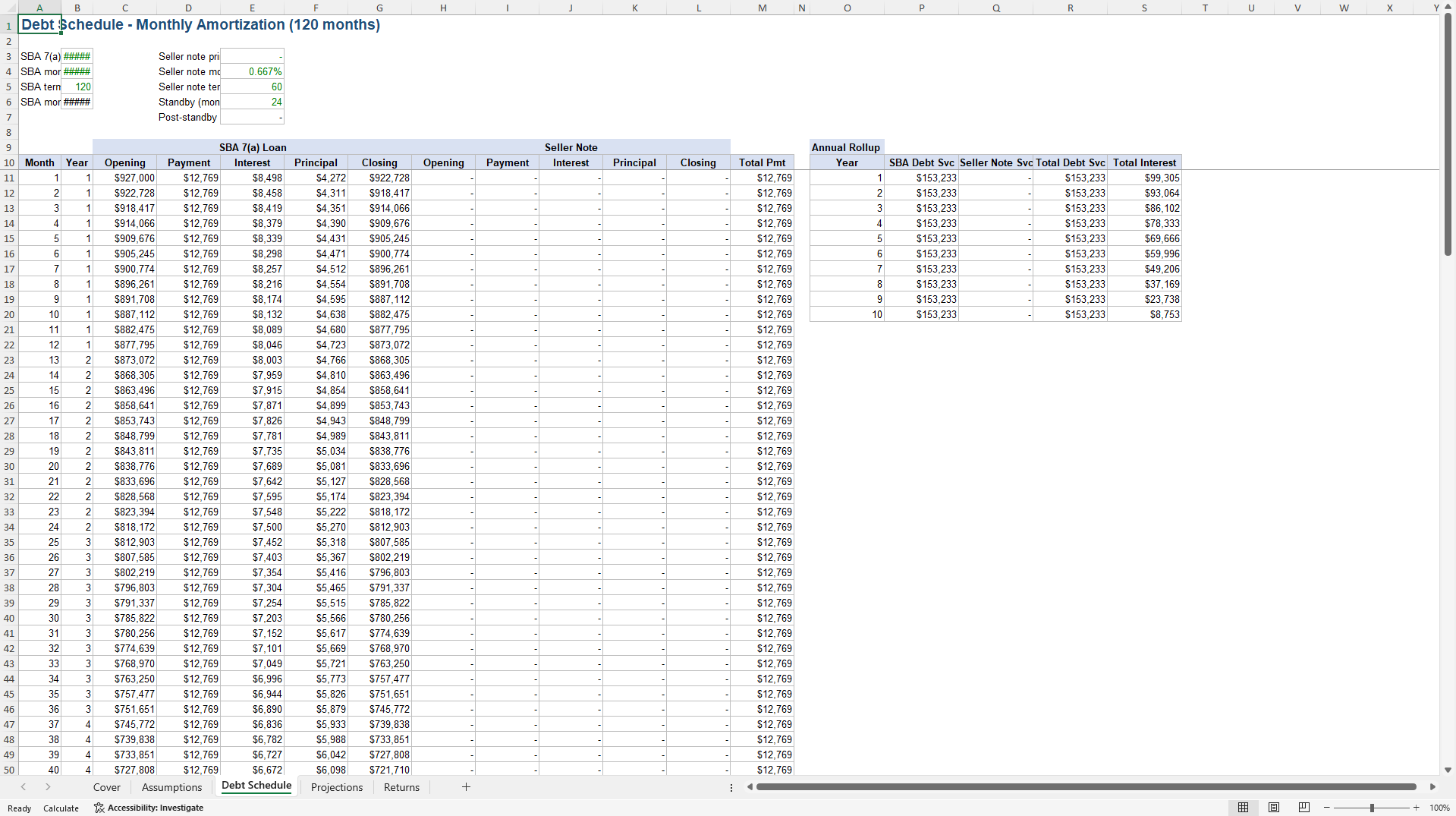
- A true 10-year MONTHLY amortization engine for the SBA loan plus an optional seller note, not an annual approximation.
- Buyer returns beside the lender view: pre-tax equity IRR and MOIC to an exit net of costs and debt, plus cash-on-cash.
M&A (MERGERS & ACQUISITIONS) EXCEL DESCRIPTION
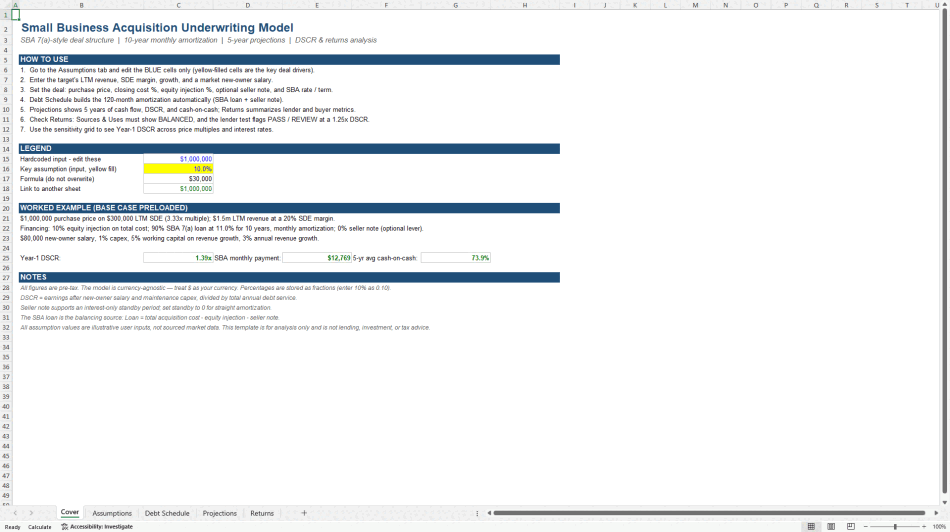
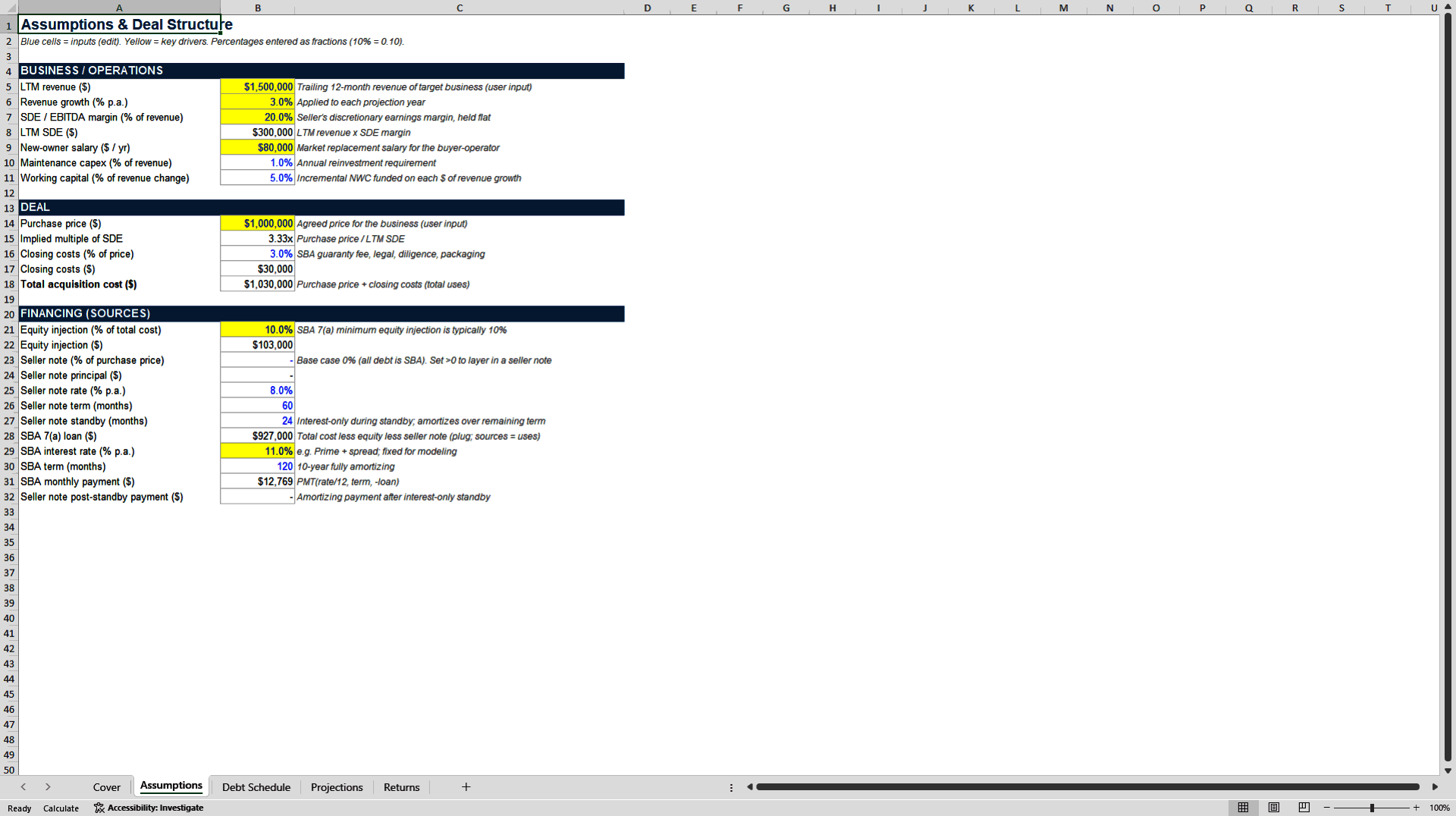
The Small Business Acquisition Underwriting Model lets you underwrite a search-fund or owner-operator acquisition the way the lender financing it will. Enter the target's last-twelve-months revenue, SDE margin, growth and a market new-owner salary, then set the deal: purchase price, closing costs, equity injection, an optional seller note, the SBA 7(a) rate and term, and your hold period, exit multiple and exit transaction costs. Everything downstream calculates itself.
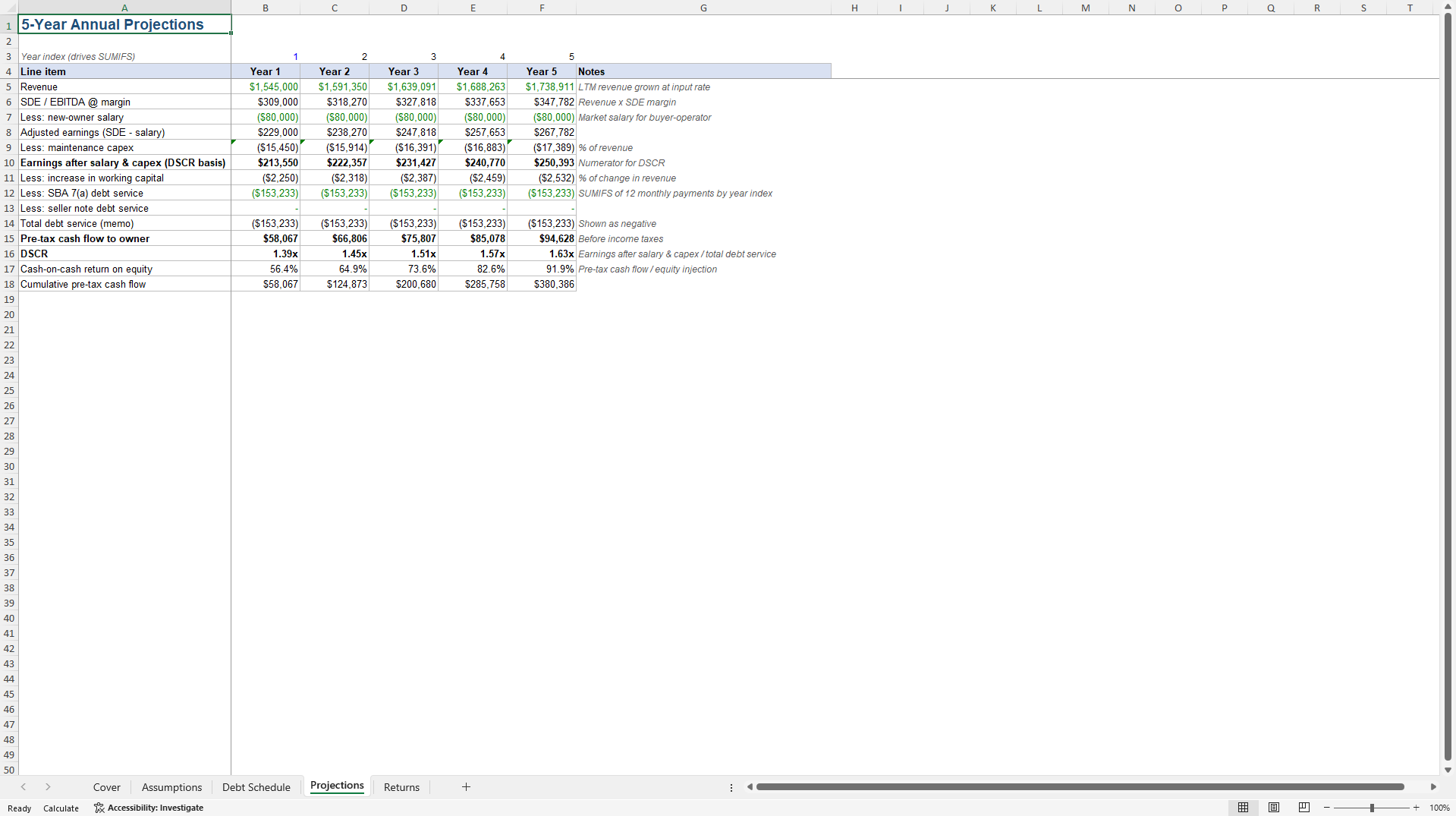
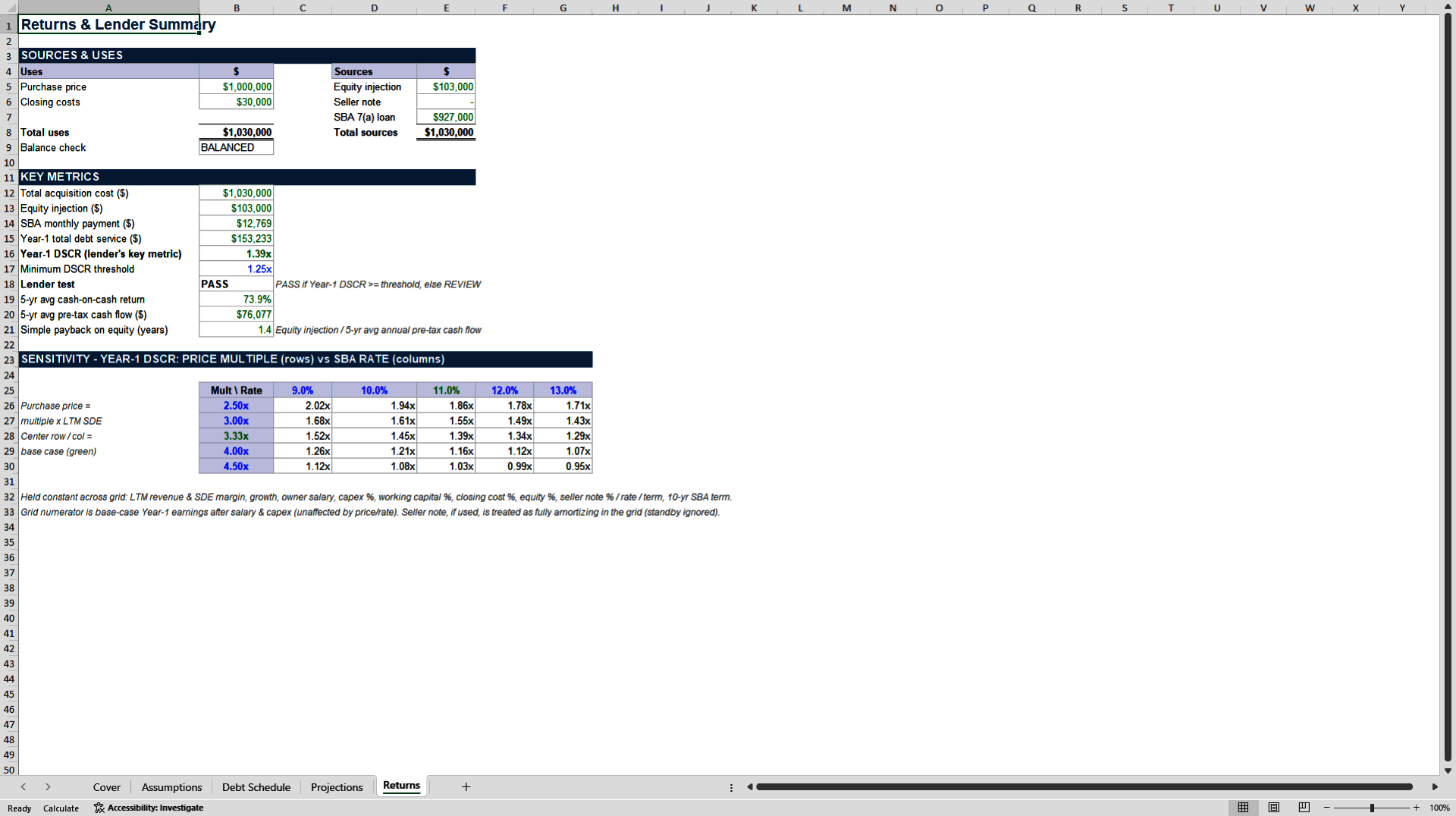
What you get is a complete, transparent underwriting workbook. A full 10-year MONTHLY amortization schedule handles the SBA loan and the optional seller note, including an interest-only standby period if you use one. Five years of projections flow through to the debt-service coverage ratio (DSCR) for each year, and the lender test flags PASS / REVIEW on Year-1 DSCR against a 1.25x threshold. A sources-and-uses block proves the deal balances to the dollar. The Returns sheet summarises the lender view (Year-1 debt service and DSCR) and the buyer's returns: Year-1 and 5-year average cash-on-cash, payback, and a year-by-year equity cash flow that ends in an exit at your multiple of exit-year SDE less exit transaction costs and the loan balances still owed, giving a pre-tax buyer equity IRR and equity multiple (MOIC).
The main highlights: an SBA-style structure with a seller-note lever; a proper monthly amortization engine rather than an annual approximation; DSCR and buyer returns computed side by side; and a two-way sensitivity grid showing Year-1 DSCR across purchase multiples and interest rates, so you can see instantly how much room the deal has before it breaks.
How to work with it: only the blue input cells are yours to change, and the yellow-filled cells are the key deal drivers to start with. Black and green cells are formulas – leave them alone. A realistic worked example is preloaded ($1.0m purchase on $300k SDE, 5-year hold, exit at the 3.33x entry multiple less 5% exit costs), and OK / CHECK cells prove that the loan balances at exit match the amortization schedule, that the equity distributions tie back to the projections, and that the IRR solves the cash flows, so you can trace the logic before trusting it.
Why you need it: business acquisitions live or die on debt serviceability, and a locked black-box template won't let you check the number that matters. This one ships fully unlocked with every formula visible, built-in integrity checks, and an honest cover sheet that discloses each assumption. Buyer returns are pre-tax (before the buyer's income tax) and driven mainly by leverage: the worked example's 10% SBA equity injection produces a very high IRR, while the same deal at 30% equity returns about 43% IRR / 3.9x MOIC, so read the IRR alongside DSCR. Currency-agnostic; treat $ as your currency. For analysis only, not lending or investment advice.
Got a question about the product? Email us at support@flevy.com or ask the author directly by using the "Ask the Author a Question" form. If you cannot view the preview above this document description, go here to view the large preview instead.
Source: Best Practices in M&A (Mergers & Acquisitions), Integrated Financial Model Excel: Small Business Acquisition Underwriting Model (SBA 7(a)-Style) Excel (XLSX) Spreadsheet, g59076599o70




























